Lonely Surfer Squaw
Description of the exhibition
On the edge of the South Saskatchewan River on an overcast winter day in 1997, Lori Blondeau poses proudly with her fun-fur bikini and tall wrap mukluks holding a pink Styrofoam surfboard. Her gaze and body language is both playful and defiant, grounded in the moment while also echoing different histories of women depicted in natural environments.
Lonely Surfer Squaw is a photographic series taken near the site of the Starlight Tours. This was a term used to describe a practice whereby the Saskatoon Police Service dropped Indigenous men outside the city limits in subzero temperatures, leading to the known deaths of Neil Stonechild, Rodney Naistus, and Lawrence Wegner. Blondeau uses this significant location to perform a repurposed 1960s pin-up girl image, dislocating it from the sandy beaches of California to the icy shores of her wintry home. In doing so, she situates her body at the intersection of the violence inflicted upon Indigenous peoples, and the sexualizing of women, with a magnetic, life-affirming radiancy.
Asinîy Iskwew
Description of the exhibition
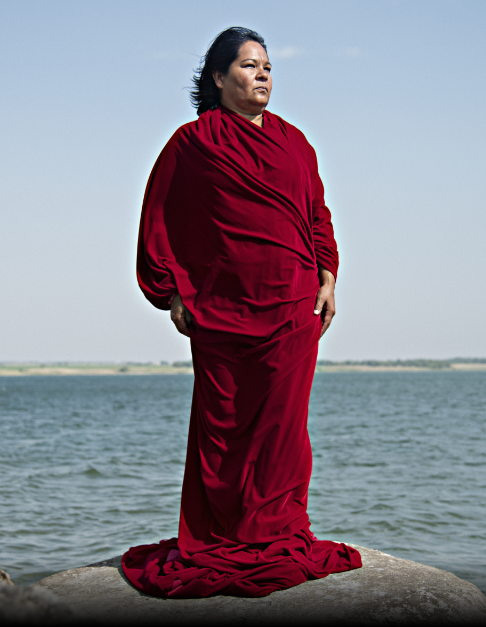
In Asinîy Iskwew, which means “Rock Woman” in Cree, Lori Blondeau captures images of herself in natural landscapes in statuesque poses that challenge conventions of memorializing in so-called Canada.
Draped in a long red-velvet robe, standing tall on plinths of natural stone around the site of Mistaseni Rock at Elbow Harbour, she highlights how enormous, sacred glacial boulders were dynamited in 1966 by agents of the Saskatchewan government to construct the human-made Lake Diefenbaker.
Unlike her earlier well-known piece Lonely Surfer Squaw (1997), also on display at the Lévis Ferry Terminal, in which Blondeau looks back at the camera in a fun-fur bikini and tall wrap mukluks holding a pink Styrofoam surfboard, in Asinîy Iskwew, she looks above and beyond at the horizon.
Through performative interventions in relation to land, rock, water, and snow, Blondeau places her body as a living beacon for history to re-emerge and transformation to occur, marking the Canadian prairies with lasting choreographies and iconography for future generations to carry forward.